
In the fast-paced world of metal fabrication, time is a critical currency that directly impacts productivity, order fulfillment, and profitability. For tube processing tasks—from flaring and beading to swaging and custom profiling—manufacturers and fabricators face a fundamental choice: rely on traditional manual processing or invest in automated Tube end forming machines. While manual methods have long been a staple in small workshops and low-volume operations, the rise of advanced forming technology has sparked a critical question: Which approach delivers meaningful time savings? A detailed analysis of cycle times, setup efficiency, error rates, and scalability reveals that tube end forming machines outpace manual processing by a significant margin, reshaping how fabricators approach tube-related tasks.
Manual Processing: Limitations of Labor-Driven Workflows
Manual tube end forming relies on skilled operators using hand tools, hydraulic presses, or basic mechanical devices to shape tube ends. While this method requires minimal upfront investment, it is plagued by inefficiencies that eat into production time. For starters, manual forming is inherently slow: a single tube end—whether flaring a copper HVAC tube or swaging a steel fitting—can take 2-5 minutes to complete, depending on the complexity of the task and the operator’s skill level. This is because each step—measuring, marking, positioning, applying force, and inspecting—must be performed manually, with frequent pauses to adjust tools or correct alignment.
Setup time is another major bottleneck for manual processing. Switching between different tube sizes, materials, or forming profiles requires reconfiguring tools, calibrating pressure (for basic presses), and conducting test runs to ensure accuracy. These setup tasks can take 15-30 minutes or longer, making manual processing impractical for high-mix production. Additionally, manual forming is prone to human error: fatigue, inconsistency in force application, or slight misalignments can lead to defective components that require rework or scrapping. Rework not only adds time but also wastes materials, further delaying production schedules.
Scalability is yet another limitation of manual processing. As order volumes increase, manual workflows struggle to keep pace—operators can only process a finite number of tubes per hour, and adding more labor increases costs without proportionally boosting output. For small fabricators taking on larger orders or growing their customer base, manual processing becomes a bottleneck that hinders growth and competitiveness.
Tube End Forming Machines: Automation-Driven Time Savings
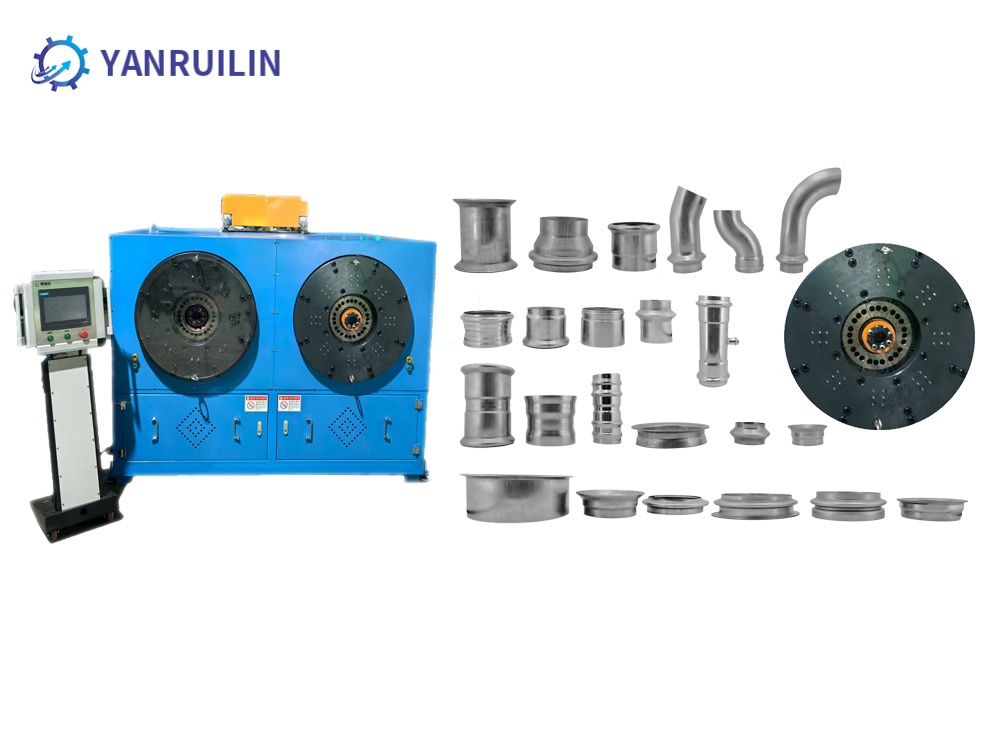
Tube end forming machines—whether hydraulic, electric servo-driven, or IO (Intelligent Operation) models—address the inefficiencies of manual processing through automation, precision, and integration. The most immediate time savings come from drastically reduced cycle times: modern forming machines can process a tube end in 5-30 seconds, depending on the task. This 4-60x speed improvement stems from automated material handling, simultaneous multi-step forming, and consistent force application. For example, a CNC-equipped tube end forming machine can load a tube, position it precisely, execute flaring and beading in a single pass, and eject the finished component—all without operator intervention.
Setup time is similarly streamlined with tube end forming machines. Advanced models feature quick-change tooling systems that allow operators to switch between forming tasks in 2-5 minutes, compared to 15-30 minutes for manual setups. Many machines also include pre-loaded forming templates and programmable controls: operators input tube dimensions, material type, and desired profile, and the machine automatically adjusts parameters (pressure, speed, tool positioning) to ensure accuracy. This eliminates the need for time-consuming test runs and manual calibration, getting production up and running faster.
Error reduction is another key contributor to time savings. Tube end forming machines deliver micron-level precision with consistent results, reducing defect rates to less than 1-2%—a stark contrast to the 8-15% defect rate common in manual processing. Fewer defects mean less rework, less time spent inspecting components, and fewer delays caused by scrapped materials. Additionally, machines integrate real-time monitoring and automatic error correction, adjusting parameters on the fly to compensate for material variations or tool wear, further minimizing downtime.
Scalability is where tube end forming machines truly shine. High-volume models can process 100-500 tubes per hour, with some systems supporting automated loading/unloading and integration with conveyor belts for continuous production. Even compact machines designed for small workshops can handle 30-60 tubes per hour—far exceeding the output of a skilled manual operator. For fabricators, this scalability means meeting tight delivery deadlines, taking on larger orders, and growing their business without being limited by labor constraints.
Real-World Time Savings: Quantifying the Difference
To put the time savings into perspective, consider a typical production run of 100 stainless steel tubes requiring flaring and beading. Manual processing would take an operator 200-500 minutes (3-8 hours) to complete, including setup time and rework for defects. A tube end forming machine, by contrast, could finish the same run in 50-300 seconds (less than 5 minutes) for cycle times alone, plus 2-5 minutes for setup—total time of 7-10 minutes. This translates to a 90%+ reduction in production time for a single run. For fabricators handling multiple runs per day or week, these savings compound dramatically, freeing up time to focus on other tasks or take on additional orders.
Beyond Cycle Times: Indirect Time Benefits
The time savings of tube end forming machines extend beyond direct production tasks. For example, machines with IoT connectivity and data logging allow for remote monitoring and maintenance scheduling, reducing time spent on equipment checks and unplanned downtime. Predictive maintenance features alert operators to potential issues (e.g., tool wear, low lubricant) before they cause breakdowns, ensuring continuous production. Additionally, the consistency of machine-formed components simplifies downstream processes—such as assembly or welding—by ensuring uniform fit and dimensions, reducing time spent adjusting or modifying parts.
Choosing the Right Approach: Context Matters
While tube end forming machines deliver clear time savings, manual processing may still have a place in niche scenarios: ultra-low-volume runs (fewer than 10 tubes), custom prototypes requiring frequent adjustments, or workshops with extremely limited budgets. However, for most fabricators—whether small workshops scaling up or large manufacturers optimizing efficiency—tube end forming machines are a strategic investment in time savings. The upfront cost of the machine is quickly offset by reduced labor hours, faster order fulfillment, and the ability to take on more profitable work.
Conclusion: Machines Win the Time Battle
In the debate between tube end forming machines and manual processing, the answer to “which saves more time” is unambiguous: automated forming machines deliver transformative time savings that manual methods cannot match. By slashing cycle times, streamlining setup, reducing errors, and enabling scalability, these machines empower fabricators to work faster, smarter, and more competitively. As manufacturing continues to prioritize efficiency and speed, tube end forming machines are no longer a luxury but a necessity for businesses looking to maximize productivity and seize growth opportunities.
For fabricators still relying on manual processing, the time to transition is now. The gap in efficiency between machines and manual labor is too large to ignore—and in an industry where every minute counts, tube end forming machines are the key to unlocking faster production, better profitability, and long-term success.
Bu web sitesi, web sitemizde en iyi deneyimi yaşamanızı sağlamak için çerezleri kullanır.

 English
 Español
 Pусский
 Deutsch
 日本語
日本語 한국어
한국어 Italiano
 हिन्दी
 Indonesia


Yorum
(0)